Litter Box Outside for a Lost Cat: Does It Really Work?
Published · 7 min read

You have probably already done it: litter box on the porch, used litter scattered on the lawn, maybe a bowl of water beside it. Every lost-pet group repeats the tip, usually with the claim that a cat can smell its litter box from a mile away. The honest answer first: there is no evidence for that. This is not a criticism — you did what everyone recommends, and it has not hurt your cat. It is simply not the thing that brings her back. Here is why, in five minutes, and what to do with that same hour instead.
Does putting the litter box outside bring a lost cat home?
No — not as a long-distance signal. No study and no experience from professional lost-pet recovery shows that a litter box guides a cat home across any real distance. What actually happens is this: almost every missing cat is only a few gardens away already. She is not failing to come home because she can't find the route. She is stuck in place because she is frightened — and a smell does not undo that.
Can a cat smell its litter box from a mile away?
Cats smell superbly — roughly fourteen times better than we do. But scent does not travel outward as a sphere; it travels as a narrow plume on the wind. Three things the myth leaves out:
- Direction: a plume goes one way only. If your cat is on the other side of the house, she smells precisely nothing — and in a built-up area the plume breaks up within a few rows of houses, against walls, hedges and roads.
- Competition: outdoors smells of barbecue, rain, exhaust, compost and twenty unfamiliar cats. Your litter is one scent among hundreds.
- Behaviour: a frightened cat does not follow a scent trail home. She takes the nearest hiding place and stays there — often 24 to 72 hours almost without moving.
The risk nobody mentions
Used litter is not a neutral smell — it is a message, and other animals read it too. A resident tomcat treats the marking as a challenge and patrols exactly the spot where you want your cat to arrive. Foxes, coyotes, raccoons and martens, meanwhile, associate cat faeces and food smell with a worthwhile food source. In the worst case the result is the opposite of what you wanted: your cat becomes even less willing to leave her hiding place.
What the myth gets right: your cat is very close
There is a true core in the tip: the assumption that your cat is within earshot. That is almost always correct. Outdoor cats are typically found within about 500 metres (a third of a mile) of home, and escaped indoor-only cats usually within the first two or three neighbouring gardens — under a deck, in a shed, behind stacked firewood, in the shrubs along a fence. Use that insight properly: you don't need a long-range lure, you need a thorough close-range search.
What to do instead
- Search physically, don't just call: go property by property with a torch, down at ground level, into every gap. The beam catches reflective eyes — even in daylight, under decks and cars.
- Search at night: between about 11 p.m. and 2 a.m. it is quiet and your cat is most likely to move. Call her name briefly, then stand completely still for a full minute and listen.
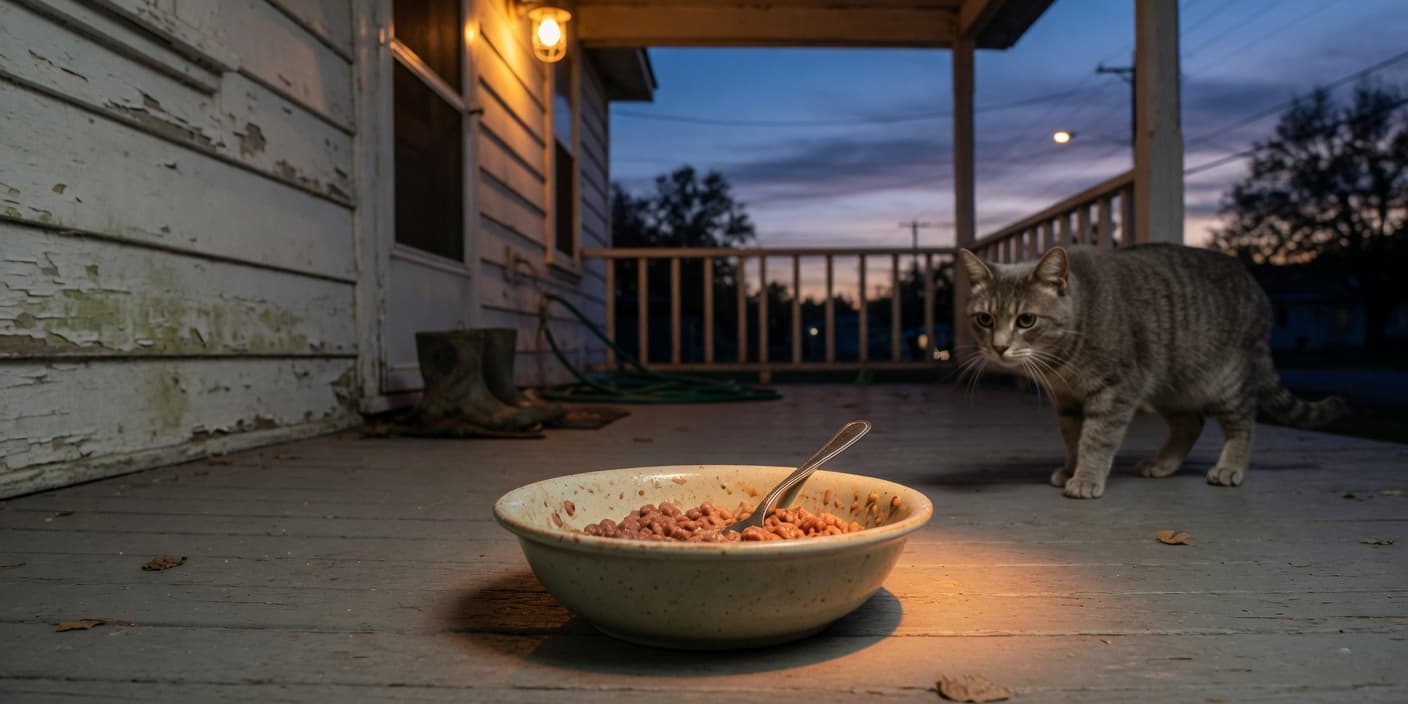
- Set up a feeding station: strong-smelling wet food, tuna or warmed chicken at the last-seen spot. Smell absolutely works at short range — just not across a mile.
- Add a trail camera: a unit costing around 60 dollars or euros tells you in one night whether your cat is eating there or whether it's a raccoon. Without a camera you are guessing.
- Activate the neighbours: ask people to check garages, basements, sheds and garden houses. More cats are accidentally shut in than are ever truly lost.
- File the reports: shelters, vet clinics, and update your microchip registry details — then get an appeal in front of the people who actually live nearby.
That last point is where a classic search fails: a poster on a lamppost reaches the twenty people who walk past it. With PawAlarm your appeal runs as an ad on Facebook and Instagram to the residents around the last sighting — which is to say, to the exact people in whose garage or hedge your cat is most likely sitting. When a sighting comes in, move the feeding station and camera there, and if she is too spooked to approach, a humane trap finishes the job. That chain brings cats home. Litter on the lawn does not.
Frequently asked questions
- Does putting a litter box outside help find a lost cat?
- Not as a long-distance lure — there is no evidence for that. The scent only drifts one way on the wind and breaks up quickly in a built-up area. It does no harm, but it is no substitute for a close-range search with a torch, a feeding station and a trail camera.
- How far away can a cat smell its litter box?
- There are no reliable figures, and the popular claim of a mile or more is unsupported. A few dozen metres with a favourable wind is realistic. More importantly, a frightened cat usually stays put in her hiding place even when she does smell something familiar.
- Does cat litter attract predators?
- Faeces and leftover food can draw foxes, coyotes, raccoons or martens, and urine markings pull in neighbourhood tomcats. Both make your already-scared cat less willing to break cover. If you leave a tray outside, at least remove the solids.
- What smell actually attracts a lost cat home?
- At short range, food does the work: strong-smelling wet food, sardines or warm chicken, placed at the last sighting in the evening. Worn clothing, the cat's bed or her blanket near the door help too, because they signal safety without advertising to every other animal around.
- How far do lost cats actually travel?
- Far less than most owners fear. Outdoor cats are usually found within roughly 500 metres of home, and escaped indoor cats often in the immediately adjoining gardens. Search close by, thoroughly and repeatedly, before you widen the circle.
You might also like
How to Lure a Lost Cat Back Home: What Actually Works
A feeding station, quiet dusk hours and an open door bring cats home — litter boxes and dirty laundry don't. Here's what actually works.
7 min read

Where Do Lost Cats Hide? (Closer Than You Think)
Why a lost cat usually sits silently nearby — and how to search methodically in the small radius where it's actually hiding.
8 min read

How to Trap a Lost Cat: Humane Trap Guide That Works
When a humane trap is the right move, how to set and bait it correctly — and how to catch even a trap-shy cat safely with a drop trap and patience.
7 min read