AirTag or GPS Tracker for Your Dog? What Works When It Counts
Published · 7 min read
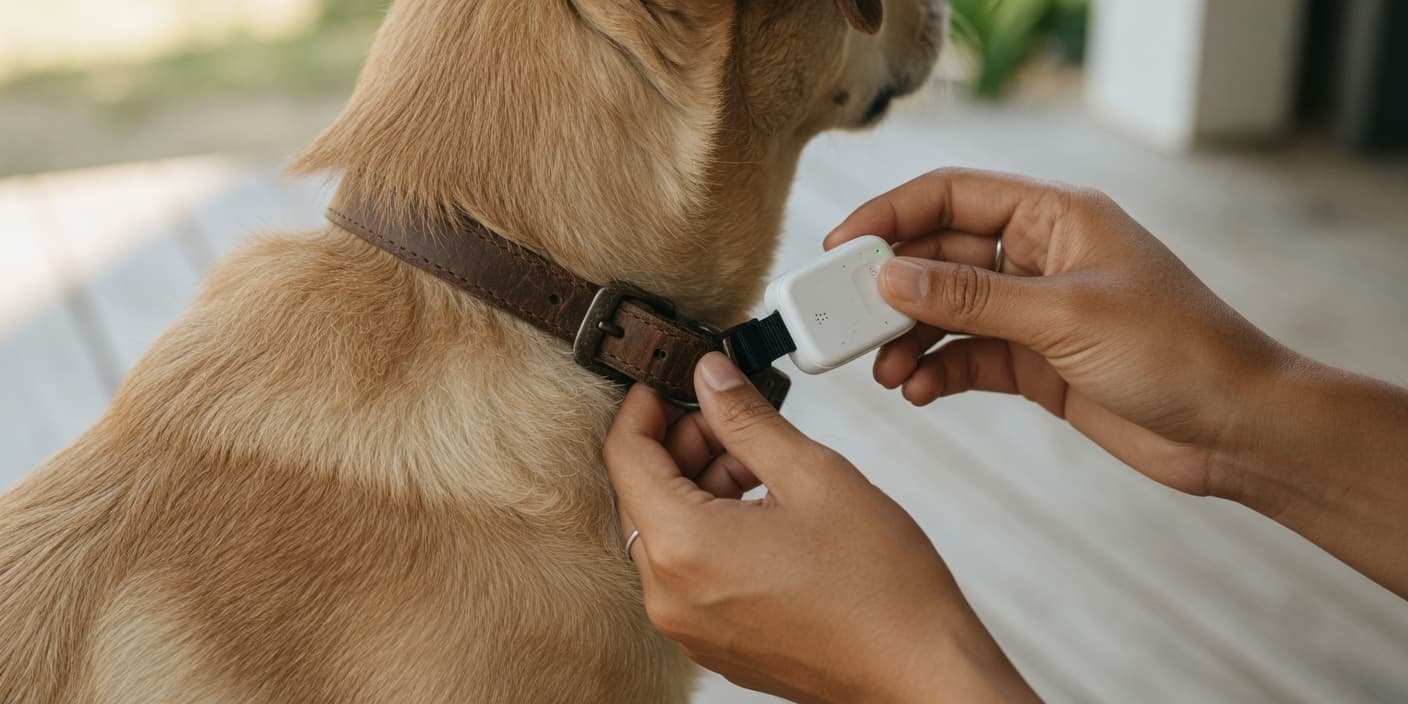
An AirTag costs around $30 and runs a year on one battery. A GPS collar costs three times that, plus a monthly fee. Both are sold against the same fear: your dog is gone and you have no idea where. The honest answer is that they solve two different problems — and where you live decides which one is worth the money. Here is what each actually does, and where both go quiet.
Does an AirTag work on a dog collar?
Yes — but as a crowd-sourced report, not as a tracker. An AirTag has no GPS and no SIM card. It broadcasts Bluetooth over roughly 30 to 100 feet (10 to 30 metres); any passing iPhone picks it up and anonymously reports its own position to you. So the dot on your map is not your dog's location. It is the location of the last stranger's phone that walked past your dog.
- Strong in town: downtown, apartment blocks, transit stops, busy footpaths — updates every few minutes, often accurate enough to name the street.
- Weak in the green: fields, woods, farmland, industrial estates at night. No people, no updates — the map can freeze for hours.
- Precision Finding walks you in over the last 30 feet or so, but only on newer iPhones and only once you are almost on top of it.
- Anti-stalking protection works against you: whoever picks up your dog gets an unknown-tracker alert on their phone and can locate and disable the tag.
- Android users need the equivalent: tags on Google's Find My Device network (Chipolo, Pebblebee) or a Samsung SmartTag — same principle, thinner network in most areas.
Apple explicitly does not market the AirTag for pets. That does not make it useless — it means there is no dog-proof mount in the box and nobody engineered it for an animal at full sprint. Use a closed silicone holder that the tag cannot pop out of, not a clip-on loop.
GPS tracker collars: live position for a monthly fee
A GPS collar tracker works out its own position from satellites and sends it to your phone over a built-in SIM. No range limit as long as there is mobile coverage — and in live mode, a fresh position every few seconds. That is the decisive difference: you follow the dog instead of reconstructing where it was.
- Real-time tracking plus route history — you can see whether your dog is still moving or has settled somewhere.
- Geofence alerts: draw a safe zone around your home and yard and get a notification when your dog leaves it — minutes after the escape, not hours.
- Cost: usually $5 to $10 a month; nothing in this class works without an active plan.
- Battery: 2 to 7 days on standby depending on model, often only a few hours in live mode. A dead tracker is a piece of plastic.
- Size and weight: 25 to 40 grams (about 1 to 1.5 ounces); most makers set a minimum dog weight around 9 pounds (4 kg).
- A dead zone is still a dead zone: in valleys, dense forest, or basements, a GPS collar can go quiet too — rarer than the AirTag, but it happens.
There is a third category for hunting and working dogs: pure radio trackers that talk directly to a handheld unit with no mobile network at all. They work deep in the woods where everything else fails, but they cost several times as much and are bulky.
Which one fits your dog and where you walk
Choose by the scenario you actually fear, not by the price tag:
- City or suburban dog that occasionally wanders out of the yard: an AirTag is enough. Plenty of phones around, short distances, low cost.
- A dog that bolts at fireworks, gunshots, or thunder: GPS tracker, no debate. Panicked dogs cover many miles in one night — straight through exactly the areas with no people in them.
- Rural home, hiking, off-leash trails, holidays in the mountains: GPS tracker. The crowd network out there is effectively empty.
- Adolescent dog still learning recall, sighthound, husky, livestock guardian, or any dog with an escape history: GPS tracker.
- Dog under about 9 pounds (4 kg): a lightweight tag on the harness only — a GPS collar is too much hardware.
Set it up so it works on the worst day
- Check the fit: two fingers between collar and neck. Sit the tracker at the side or underneath, not on top of the neck where rough play strips it off.
- Fix a charging slot: pick one weekday and charge every week, plus any time it drops under 30 percent. Replace the AirTag battery once a year without waiting for the warning.
- Set the safe zone: draw the geofence around home and yard, allow notifications permanently, and set the app's location permission to Always.
- Test it once before you need it: have someone carry the tracker 500 metres away and try to find them. You will learn more in ten minutes than from any manual.
- Add a visible ID tag: a plain metal tag with your phone number brings dogs home faster than any electronics — the finder has to install nothing.
What no tracker replaces
The microchip. It needs no power, transmits nothing, and cannot be taken off — in exchange it shows no position, it proves ownership. Every shelter and vet practice scans for it. What matters is the registration: a chip registered to a phone number you gave up three years ago is worthless. Check your entry with your registry today; it takes five minutes.
And the uncomfortable part: the vast majority of lost dogs are wearing no tracker at all. Even with one, what you end up holding is a single usable fact — a last known position. That is where the search starts, not where it ends. Around 93 percent of lost dogs are recovered, and what decides it is how many people around that point know within the first hours. That is exactly the job PawAlarm does: your appeal goes out as Facebook and Instagram ads to residents around the last known location, along with a printable poster with a QR code. The technology tells you where — the neighbourhood brings the dog home.
Frequently asked questions
- Does an AirTag actually work for tracking a dog?
- Yes, but only where plenty of people with iPhones are around. An AirTag has no GPS: it is detected by nearby Apple devices, which report their own position to you. In a city you can get updates every few minutes; in woods or farmland you may get nothing for days.
- Is a GPS tracker better than an AirTag for dogs?
- Technically yes: a GPS collar gives live position, escape alerts, and no range limit. It also costs a monthly fee, needs charging every few days, and is too heavy for very small dogs. Rule of thumb: low-risk city dog — AirTag; panicky, rural, or hunting dog — GPS tracker.
- How much does a GPS dog tracker cost per month?
- Typically $5 to $10 per month, cheaper on annual or multi-year plans, plus roughly $50 to $100 once for the device. Without an active plan the built-in SIM is dead and the tracker sends nothing. An AirTag has no running cost beyond one coin battery a year.
- Do I still need a microchip if my dog wears a GPS tracker?
- Absolutely. The chip is the only proof of identity that cannot run out of battery, fall off, or be removed. Collars break, batteries die, tags get taken off — the chip stays. Just make sure your contact details in the registry are current.
- How long does a GPS dog collar battery last?
- Two to seven days on standby depending on the model, and often only a few hours in live tracking mode. That is why charging belongs in a fixed weekly routine — a tracker that happens to be flat on the night your dog bolts helps nobody.
You might also like

How to Prevent Your Pet From Getting Lost
A microchip, an ID tag, and a few habits dramatically cut the odds your pet ever goes missing — and prepare you for a fast reunion if it does.
7 min read

My Pet Is Microchipped — Will the Chip Help Find It?
A microchip only brings your pet home if the registry has your current details — here is how registries work and the 10-minute check to do today.
6 min read

How Far Do Lost Dogs Travel? Set Your Search Radius Right
Temperament, what spooked them and the terrain decide how far a lost dog goes — and how to plan your search radius wisely.
7 min read