How to Find a Lost Dog at Night: Where Dogs Go
Published · 7 min read
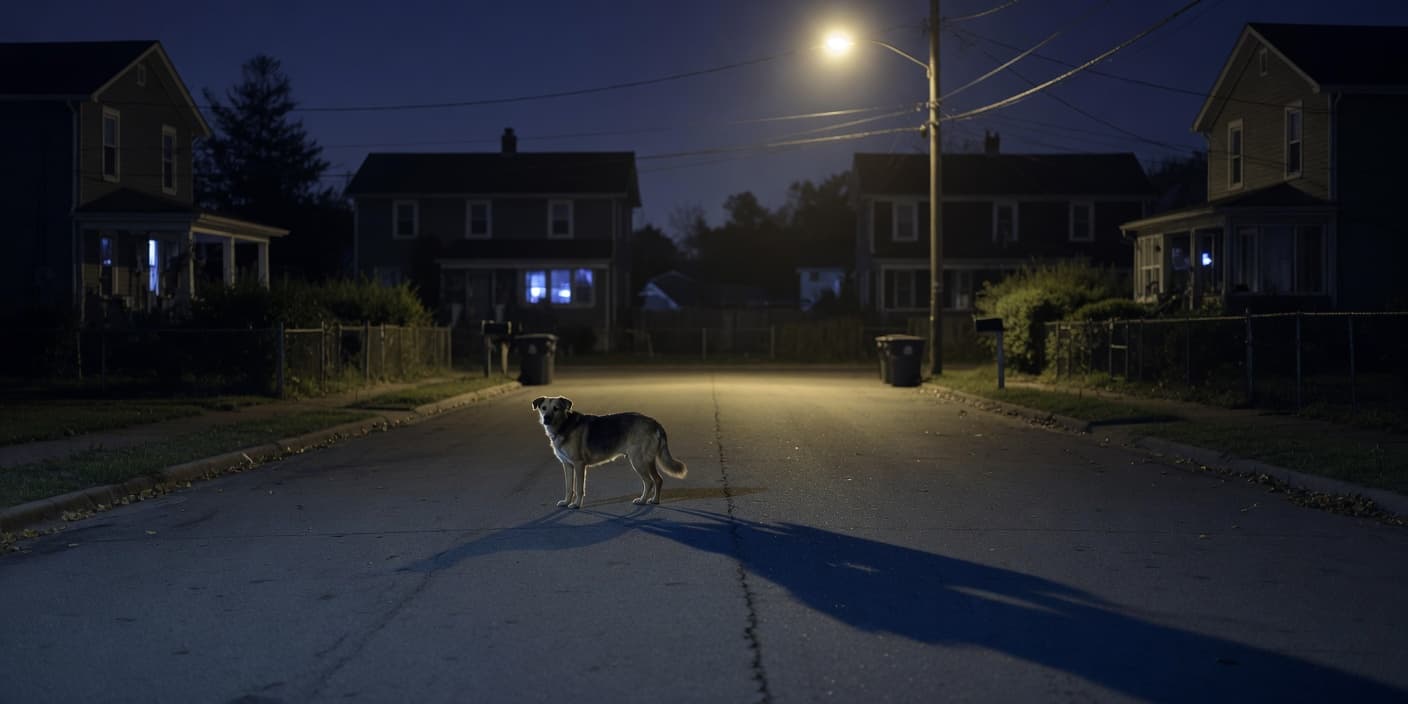
It is dark, your dog is out there somewhere, and everything in you says the search stops until morning. It doesn't. Night is often the best searching window of the whole day: traffic disappears, building sites and industrial estates empty out, other dogs stop passing — and a frightened dog that would not leave its hiding place in daylight finally stands up, drinks, looks for food and moves. That is exactly when you can hear it and see it in a torch beam. The one condition: search the night differently from the day. Slowly, quietly, alone or in twos.
Where do lost dogs go at night?
A frightened dog does not bed down in the open. It looks for a small, dark pocket of cover with its back protected and a clear view out, lies down, and often stays there for hours. The usual spots:
- Under decks and porches, garden sheds, caravans, trailers and parked cars.
- Inside dense hedges, brambles, evergreen shrubs and the tall grass along field edges.
- In industrial estates, on building sites, behind warehouses and loading bays — deserted at night, full of cover by day.
- In drainage pipes and culverts, under bridges, along railway and motorway embankments.
- In garages, barns, stables and outbuildings that somebody closed up at dusk without looking inside.
On distance: a dog that bolted in panic can cover several kilometres in the first hour — then it usually settles somewhere it feels safe and returns to that same place night after night. Small, elderly or unwell dogs stay far closer. A confident dog that simply followed a scent behaves differently: it keeps travelling, usually along paths, streams and roads.
Will my dog survive a night outside?
Almost certainly yes. A healthy adult dog with a normal coat gets through a dry night above freezing without harm — it finds cover exactly as described above. Around 93 per cent of lost dogs are eventually recovered. The real dangers are not the darkness itself but roads, water, and cold for small, short-coated, very young, elderly or medication-dependent dogs. So your job tonight is not to grab your dog at any cost. It is to find out where it is without pushing it further away.
How to search for a dog at night
Slowly, quietly, and with light — almost the opposite of a daytime search party. A large group calling out will push a scared dog kilometres ahead of it.
- Search alone or in twos. Every extra person lowers the chance your dog will show itself.
- Walk at normal pace, or drive at 10 to 15 km/h (6 to 9 mph) with the windows down and the radio off.
- Every 100 to 200 metres, stop completely. Call once in your ordinary, cheerful everyday voice — the tone you use at dinner time — then stay silent for two full minutes and listen.
- Use sound instead of volume: jingle the lead clip, shake the treat tin, squeak the familiar toy, slam the car door. These carry further than shouting and frighten nobody.
- Sweep the torch slowly at your own eye level, along the bottom of hedges, under vehicles, into gaps. A dog's eyes throw back a bright green-blue shine visible at 50 metres or more. That eye-shine is the single biggest advantage night gives you.
- Log every response with the time and the exact spot: a bark, a rustle, a chain rattling. Two responses in the same field on two nights is a location, not a coincidence.
Make home and the last sighting the anchor
Dogs navigate back by smell and habit. So spend part of the night making your home and the last-seen spot smell and sound the way they always do:
- Leave the garden gate, garage or shed open, with water and a worn T-shirt or unwashed bedding inside.
- Put your dog's bed and an unwashed blanket right outside the door.
- At the last confirmed sighting, build a scent station: worn clothing plus strong-smelling food — warm roast chicken, tinned fish, tripe.
- Don't scatter food over a wide area. One station you can check at first light tells you more than five you can no longer read.
- If you can: park your car at the last-seen point, open the boot, and sit in it. A car that smells right with its person inside has brought back more dogs than any search line.
Night sightings, and when to stop
When somebody calls at two in the morning, the worst thing you can do is drive up and run. Ask first: exact location, direction of travel, time, was there a collar. Ask them to keep their distance, not to call the dog, and above all not to chase it — just to watch from far off and keep you updated. Then drive over calmly and park a good distance away.
If you see your dog, do not walk towards it. Crouch down, turn side-on, avoid direct eye contact, yawn, and toss food in its direction — not at it. Then sit down and wait. A dog in flight mode sometimes fails to recognise its own people for several minutes; it needs those minutes. If it runs, do not follow at speed — note the exact direction instead.
And at some point, call it a night: search until roughly one or two o'clock, sleep three hours, and be back outside half an hour before sunrise. First light is the most active time for a loose dog, and mistakes made while exhausted cost more than the hour you skipped. Keep your appeal running in the meantime: with PawAlarm your alert reaches the residents around the last sighting as an ad on Facebook and Instagram — including the people who head out with their own dog at six and see yours first.
Frequently asked questions
- Where do lost dogs go at night?
- Almost always into tight, dark cover with their back protected: under decks and porches, caravans and parked cars, inside dense hedges and brambles, in empty industrial estates, under bridges and inside drainage pipes. A frightened dog lies down there and often stays for hours. Those are exactly the places to sweep with a torch after dark.
- Should I keep searching for my dog at night or wait until morning?
- Keep searching at night, but quietly and in small numbers. The streets are silent, traffic has stopped and your dog is moving — so you can hear it and catch its eye-shine in a torch beam. Search until about one or two in the morning, then be back out half an hour before sunrise.
- Will my dog survive a night outside?
- In almost all cases, yes. A healthy adult dog with a normal coat comes through a dry night above freezing unharmed and finds its own shelter. Around 93 per cent of lost dogs are eventually recovered. Higher risk applies to small, short-coated, very young, elderly or medication-dependent dogs — and to roads, always.
- My dog has been missing overnight — what should I do first in the morning?
- At first light, check the food and scent station at the last sighting and look for tracks in dew, snow or dust. Then, before eight o'clock, report the dog to local shelters, the police or dog warden, and your microchip registry, and widen the search radius. The hours around sunrise are the most active time for a loose dog.
- Do lost dogs come home on their own at night?
- Many do — which is why one way in should always stay open and lit: a gate, garage or shed with water and worn clothing inside. Some dogs only come back on the second or third night, when hunger finally outweighs fear. So don't clear away the scent station too early.
You might also like

Lost Dog: What to Do in the First 24 Hours
A calm, step-by-step action plan for the first 24 hours after your dog goes missing.
7 min read

Dog Ran Away Scared: What to Do When Your Dog Bolts in Panic
Why panicked dogs run blind and far — and how to bring a scared dog home instead of accidentally driving it further away.
8 min read
How to Catch a Scared Lost Dog That Won't Come to You
Catching is technique, not a chase: how calming signals, a feeding station, and patience bring home even a dog in full survival mode.
8 min read