Dog Ran Away During Fireworks: What to Do Right Now
Published · 7 min read
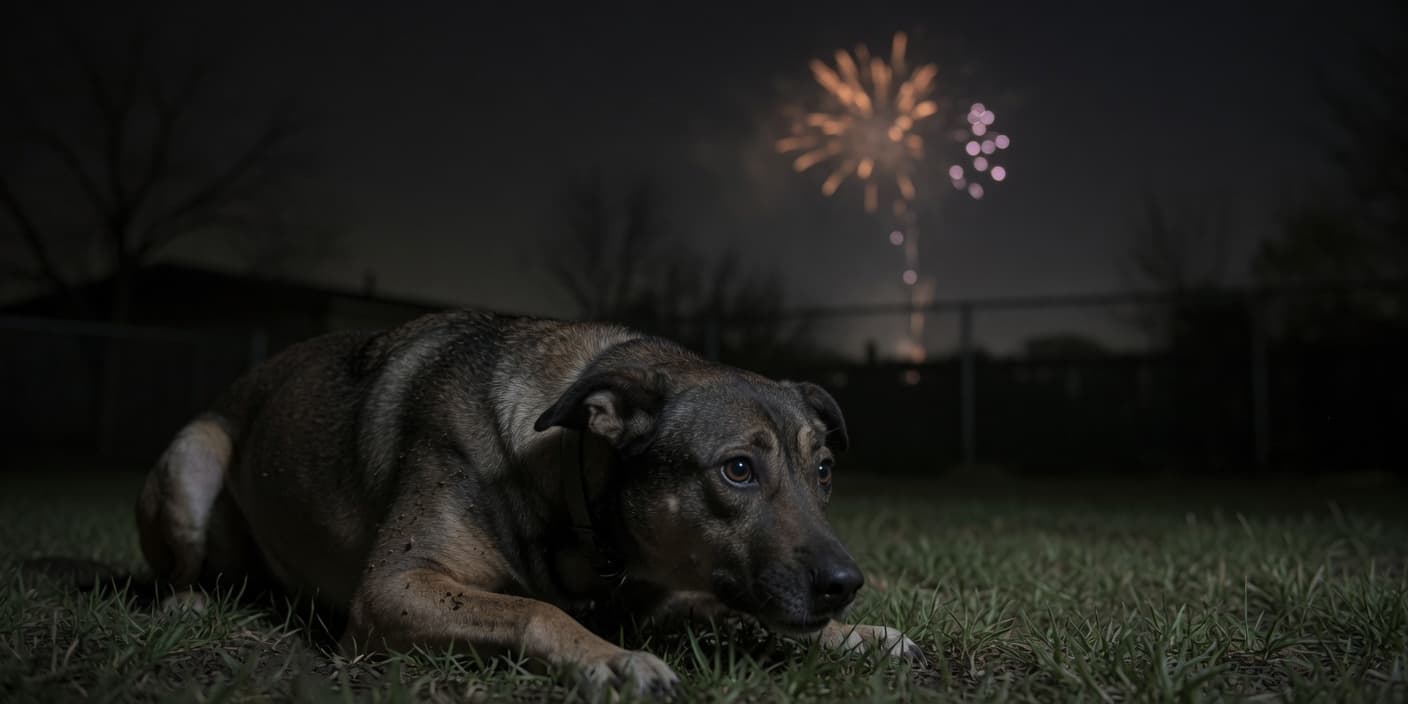
One bang, one lunge, and the leash is empty. A dog that bolts during fireworks is not disobeying you — it is in survival mode, running blind from a noise it cannot escape. That is exactly why the usual things fail on this night: calling its name, running after it, driving around with the window down. A calm, methodical first hour is worth more than a whole day of frantic searching. Here is the order that works.
The first hour: what to do right now
Stay at the spot where your dog broke away, and make that spot smell like home. Panicked dogs run in a straight line until the noise stops, then navigate back toward familiar scent — often to the exact point where they got loose.
- Do not chase. A human running behind a panicked dog pushes it further out, often across roads.
- Leave a scent anchor at the escape point: a worn shirt or sweater, the dog's bed or blanket, and its unwashed water bowl. Wash nothing, and do not move any of it later.
- Add a bowl of strong-smelling food — warm rotisserie chicken or wet food travels a long way in cool night air.
- One person stays at the spot, seated and quiet, while the others alert. Two calm searchers beat six people shouting.
- Report it immediately: local shelters, animal control, the police non-emergency line, and every emergency vet within 15 kilometres. Injured dogs get picked up by strangers and driven to the nearest clinic.
Then write the description down once — colour, size, collar, microchip number, your mobile — so every call and post afterwards says the same thing. And flag the microchip as lost with the registry the same night; a found dog is only as findable as the phone number on file.
How far will a dog run when it is scared of fireworks?
Further than you expect. In survival mode a dog often puts several kilometres between itself and the bang within the first hour, and a large, athletic dog can cover ten kilometres or more in a single night. Small, short-legged and older dogs usually stay much closer and go to ground after a few hundred metres.
- Search a radius of about 3 kilometres around the escape point on day one; with no sightings, widen to 8-10 kilometres on day two.
- Map what stops a dog: motorways, rivers, fenced railway lines. Otherwise it follows the path of least resistance — footpaths, hedgerows, field edges, canal towpaths.
- A dog in flight will not answer to its name and will run from you if you walk at it head-on. That is normal, not a broken bond.
- The large majority of lost dogs are recovered — around 93 % in the studies that have measured it. The ones that come home are the ones whose owners keep sightings coming in.
The first night, and why dawn matters
Fireworks nights — the Fourth of July, New Year's Eve — stay loud until well past midnight. Your dog keeps moving while the bangs continue, then beds down at first light in the densest cover it can find: brambles, a hedge, under a shed, inside a drainage culvert. That makes the hour after sunrise your best window of the whole search.
- Search at dawn and dusk, quietly, on foot, alone or in pairs. Bring the squeaky toy and the treat pouch, not a whistle.
- Bring a dog your dog knows, if you have one — a familiar dog reads as far less threatening than a person.
- Leave the food and scent station out all night and check it at first light for tracks, flattened grass, or food eaten.
- After a sighting with no catch, stop searching that spot and start feeding it. A trail camera on the food tells you what time to be there.
Alert the neighbourhood faster than your dog can leave it
Someone else will almost certainly see your dog before you do. So the job on night one is not to find it yourself — it is to make sure that person knows who to call.
- Posters at the escape point and at every junction and dog-walking entrance in the radius: big photo, one word (LOST), one phone number readable from a moving car.
- Posts in the local Facebook groups, the neighbourhood app and the regional lost-and-found pages — with the exact street, the time, and a clear photo.
- Call shelters, vets and animal control now, and again in 24 hours; found dogs are often reported a day or two late.
- Paid geo-targeted ads reach the people who are in no group at all. With PawAlarm your appeal goes out as a Facebook and Instagram ad to residents around the escape point, and you get a printable poster with a QR code; on paid cases we also email the vets, shelters and rescues in the area.
Ask everyone for the same thing: do not chase, do not call the dog, phone you with the time and the place. Sightings are what turn a search into a plan.
Before the next fireworks night
The Fourth of July, New Year's Eve and summer thunderstorms come back reliably — and preparing for them takes one evening.
- Set up a safe room in the innermost part of the house: blinds down, curtains closed, a radio or TV as a sound blanket, a den of blankets to crawl into.
- Last walk before dark, on a leash — even in a fenced garden. Panicked dogs jump and dig through fences that have held for years.
- Collar with an ID tag and your mobile number, plus a well-fitted escape-proof harness. Check the phone number on the microchip registry now, not on the day.
- If your dog is already noise-phobic, talk to your vet weeks ahead about anxiety medication and start sound desensitisation training. Medication bought on the evening itself comes too late.
For tonight, hold on to this: your dog is not gone, it is frightened. Scent anchor at the escape point, sightings coming in, calm search at dawn. Most of these nights end with a tired, filthy dog walking back to the one place that still smells like you.
Frequently asked questions
- What should I do if my dog ran away during fireworks?
- Stay at the escape point and leave worn clothing, the dog's bed and strong-smelling food there. Do not chase and do not shout. Report the dog immediately to local shelters, animal control, nearby emergency vets and the microchip registry, and get an alert out to the surrounding neighbourhood at the same time.
- How far will a dog run when scared of fireworks?
- Often several kilometres within the first hour, and ten kilometres or more overnight for a large, athletic dog. Small and older dogs usually stay much closer. Search about a 3-kilometre radius around the escape point on day one and widen to 8-10 kilometres if no one has seen the dog by day two.
- Will a scared dog come back on its own?
- Many do, once the panic drops and it goes quiet — usually around dawn, and usually to the escape point or the front door. That is why it matters to make that spot smell like you and to leave food and water out overnight. Keep your phone on and keep the scent station untouched.
- Should I search at night or wait until morning?
- Both, but for different jobs. While the fireworks are still going the dog keeps moving, so the night is for reporting, posting and putting up posters. The real searching belongs to dawn and dusk, because panicked dogs bed down in dense cover at first light. Move slowly, quietly, and do not call.
- My dog ran off during a thunderstorm — is it the same?
- Yes, the flight response is identical; only the weather differs. Rain washes away scent trails, so put the scent anchor and food under a porch, carport or shelter. And check covered places first — carports, sheds, culverts, under bridges and decks are where storm-panicked dogs lie up.
You might also like

Dog Ran Away Scared: What to Do When Your Dog Bolts in Panic
Why panicked dogs run blind and far — and how to bring a scared dog home instead of accidentally driving it further away.
8 min read
How to Catch a Scared Lost Dog That Won't Come to You
Catching is technique, not a chase: how calming signals, a feeding station, and patience bring home even a dog in full survival mode.
8 min read

Lost Dog: What to Do in the First 24 Hours
A calm, step-by-step action plan for the first 24 hours after your dog goes missing.
7 min read
Dog scared of fireworks? How to keep dogs and cats calm
A calm plan for fireworks nights: ID and harness checks, a safe room, ear protection, a word with your vet, and a poster kit ready in case your pet bolts.
10 min read