Lost Senior Dog: Why Old Dogs Wander Off and Where to Look
Published · 7 min read
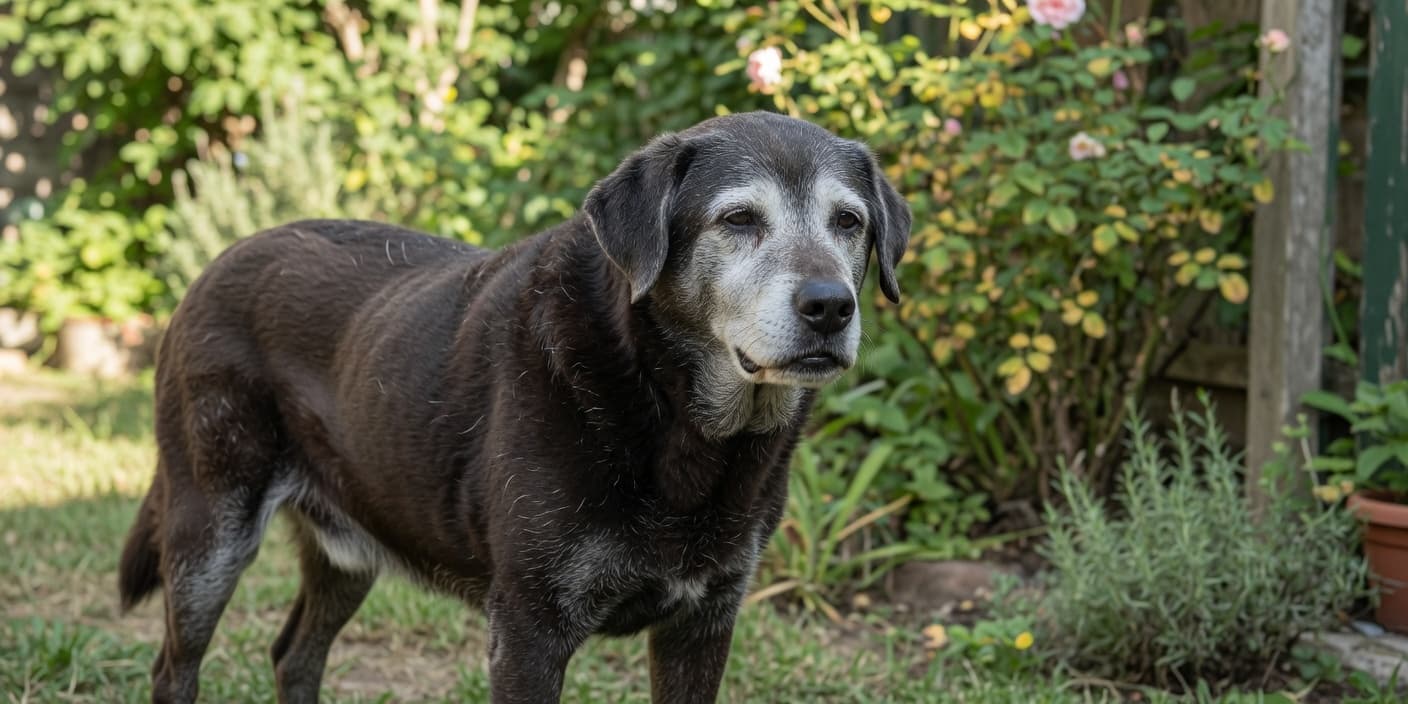
An old dog that has gone missing is not doing what people say old dogs do. The idea that senior dogs go away to die alone is folklore, not behaviour. What actually happens is far more ordinary and far more fixable: your dog walks through a gate someone left open, loses the thread of where it is, and cannot work out how to get back. It hears less, sees less, and the mental map that worked for a decade has gone blurry. It is not leaving you. It is stuck — and usually much closer than you fear.
Do old dogs wander off to die?
No. There is no evidence that dogs go looking for a place to die, and vets who treat dying dogs see the opposite: sick, weak animals lie down and seek shelter, they do not set off on a journey. What looks like a deliberate goodbye is almost always disorientation — the dog got out, got confused, and could not navigate home. That difference matters enormously in practice, because a disoriented dog can be found, and most are. Around 93 percent of lost dogs are recovered, and senior dogs in particular turn up close to home, simply because they do not cover much ground.
Why senior dogs get disoriented and wander off
Old dogs go missing for reasons that are mostly medical, not emotional. These factors almost always stack up together:
- Canine cognitive dysfunction, the dog version of dementia: roughly a quarter of dogs aged 11 to 12 and more than two thirds of dogs aged 15 to 16 show signs — staring at walls, getting stuck in corners, pacing at night, failing to recognise a familiar route.
- Hearing loss: your dog cannot hear you calling, cannot hear traffic, and does not register the open gate as a boundary.
- Failing eyesight and clouded lenses: landmarks blur, and unfamiliar ground turns into a barrier.
- Night-time restlessness: many escapes happen between dusk and about 3 a.m., when the dog is awake, anxious and pacing.
- Perfectly mundane triggers: a delivery driver or builder leaving the gate open, a thunderstorm, fireworks, a fence panel down after a storm.
Every one of these makes the search harder and easier at the same time: harder because your dog will not respond when called — easier because it will not have gone far.
Where lost senior dogs actually end up: close, low and downhill
An old dog takes the path of least resistance every time. It does not climb, does not jump, and does not reverse out of tight spots. So search here first:
- Downhill and on level ground — old joints avoid any climb. Start below the point of escape, not above it.
- Along fences, hedges and walls: whatever line your dog walked beside is the line that steered it.
- Into dense cover it walked into and cannot back out of — hedges, brambles, long grass, ditches, culverts.
- Underneath things: decks, garden sheds, parked cars, trailers, porch steps, farm buildings.
- Near water — streams, ponds, drainage ditches. Old dogs seek water out, and steep or muddy banks become a trap.
- In garages, sheds and basement stairwells that happened to be open at the time and were closed afterwards.
That last one is why the most productive thing you can do in hour one is not searching but knocking. Ask every neighbour within a few hundred metres to physically walk their own garden, open the shed and garage, and look under the deck. A great many senior dogs are found 100 to 500 metres (roughly 100 to 500 yards) from home, on somebody else's property, shut in or too weak to make themselves heard.
How to search for a deaf or blind dog
Search with your eyes, not your voice. A deaf dog cannot hear you call, and a dog with dementia may no longer recognise its name as a signal. Calling costs nothing, but it will not do the work for you.
- Go on foot, not by car. A senior dog often lies still in undergrowth — you will drive past that in five seconds.
- Search low and visually: under every hedge, into every ditch, behind every woodpile, under every parked vehicle. Carry a torch even in daylight.
- Stop every 50 metres and listen for a full 30 seconds. An exhausted old dog whimpers quietly instead of barking.
- Keep searching after dark. It is quieter, and a strong beam held at ground level picks up reflective eyes from a long way off.
- Put a worn blanket, your dog's bed and a bowl of water outside your gate — familiar scent holds a dog that wanders back into the area.
- Walk the same streets several times, morning and evening. A dog asleep under a deck on your first pass may be standing at the fence on your third.
Alert the whole neighbourhood in the first hour
Because your dog will not travel far and often ends up in someone else's garden or shed, you win this search with pairs of eyes in a small radius, not with kilometres covered. Report the dog to local shelters, to every vet and emergency clinic within about 20 kilometres, and to the police or council warden, and update your phone number in the microchip registry immediately — on a senior dog, the chip was often registered many years and one phone number ago. Then reach the people who can actually check their gardens: with PawAlarm your appeal reaches residents around the last known location as an ad on Facebook and Instagram, and you get a print-ready poster with a QR code for fences, the local shop and the vet's waiting room.
Tell finders exactly what to do: approach slowly, crouch down, never grab from behind, offer food, secure the dog in a garden or indoors, then call. A confused old dog startles easily but can rarely run — a calm voice and a lead are usually enough. And do not stop too early: senior dogs are regularly found days later, because they were shut in somewhere and simply had to wait until someone opened the right door.
Frequently asked questions
- Do old dogs wander off to die?
- No — that is a myth. Dying or seriously ill dogs lie down and seek shelter rather than set off walking. What looks like a goodbye is almost always disorientation caused by dementia, deafness or failing eyesight: the dog got out and could not find its way back. So keep searching. Your dog got lost, it did not leave.
- How far can a senior dog wander?
- Far less than a young one. Most old dogs are found 100 to 500 metres from where they escaped, and rarely more than about a kilometre (half a mile) away. Search that close radius thoroughly and on foot before widening the area, or you will walk straight past your dog.
- My deaf dog is lost — how do I search for it?
- Calling achieves little with a deaf dog, so search visually and slowly on foot. Shine a torch into every hedge, ditch and space under a deck, and pause every 50 metres to listen for half a minute. At night, sweep a strong beam at ground level: a dog's eyes reflect light from a considerable distance.
- Will an old dog find its own way home?
- Some do, but do not count on it. The exact ability that would get your dog home — navigation — is what dementia and poor eyesight take away first. Leave a blanket, the dog's bed and water by your door as an anchor, and keep searching actively in parallel.
- How long can an old dog survive outside?
- Considerably less time than a young, healthy dog, especially in heat, cold, or without its medication. Think in hours rather than days, and search through the night as well. Even so, old dogs are regularly found alive after several days, often shut inside a garage or shed.
You might also like

Lost Dog: What to Do in the First 24 Hours
A calm, step-by-step action plan for the first 24 hours after your dog goes missing.
7 min read

How Far Do Lost Dogs Travel? Set Your Search Radius Right
Temperament, what spooked them and the terrain decide how far a lost dog goes — and how to plan your search radius wisely.
7 min read

Lost Dog Syndrome: Why Your Dog Runs From You
Why a frightened dog in flight mode stops recognizing even its owner — and how to calmly win it back.
8 min read
When to Stop Looking for a Lost Pet? Read This First
Why the search is almost never over when you are exhausted — and how to switch from daily searching to a routine you can sustain for months.
8 min read