Newly Adopted Dog Ran Away: The First-72-Hours Playbook
Published · 8 min read
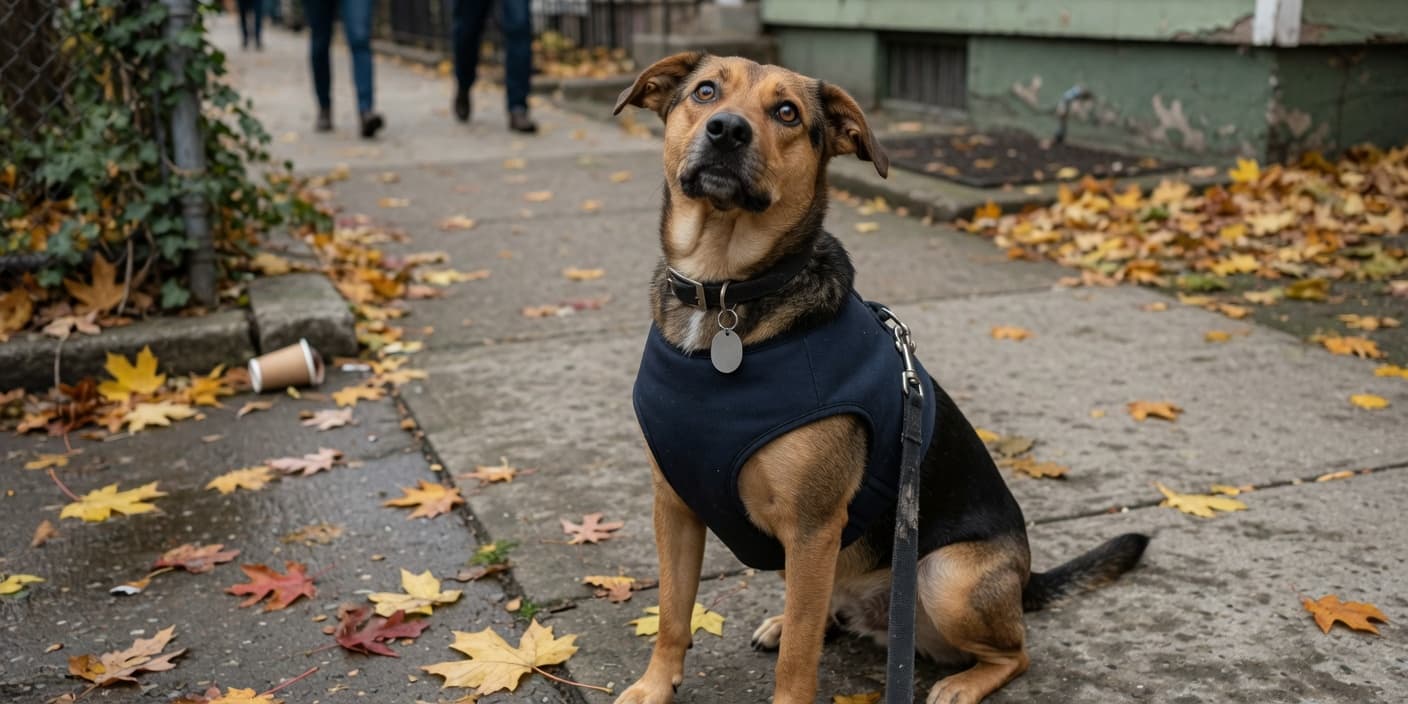
You have had the dog for two days — and now it is gone. Out of the yard, through the front door, backed out of its harness. This is the highest-risk escape scenario there is, and you should know why: a newly adopted dog has no bond to your home yet. It will not come back, because it does not have a home to come back to. It will not answer to its name, because the name is days old. And it will run from you too — not out of ingratitude, but because its brain has switched into survival mode. The good news: that behaviour is predictable, and predictable behaviour turns into a plan.
Why a newly adopted dog behaves like a stray
Because right now, it is one. Bonding takes weeks, not days. What you are dealing with is an animal whose entire world changed within a few hours: new smells, new sounds, new people. Add one fright and a bolt, and the flight system shuts everything else down.
- It ignores its name — the name is a few days old and attached to nothing familiar.
- It runs from you as well: to a panicked rescue dog, you are still a stranger who is shouting and following.
- It travels further than an established family dog — 5, 10, sometimes over 20 kilometres in the first 24 hours is documented in panicked dogs.
- It moves at night and at dawn and dusk, and lies hidden by day in thickets, field edges, woodland margins, garden hedges.
- It will usually only take food when no one is visible — but it does take food. That is your single biggest lever.
Even so: over 90 percent of lost dogs are recovered. What decides it is whether you follow your instincts (call, search, chase) or the method.
The 3-3-3 rule — and why escapes cluster in the first days
The 3-3-3 rule describes how an adopted dog settles in: roughly 3 days completely overwhelmed, roughly 3 weeks to learn the routines and relax, roughly 3 months to truly arrive and bond. Almost every escape happens inside that first window, for two reasons. First, the dog is at its most reactive in those days: a slamming car door, a firework, a strange dog is enough. Second, new adopters underestimate the escape risk precisely then — the dog has never pulled on this leash, never gone through this gate, never shown you that it clears a 1.6-metre fence.
The first 72 hours: what to do, in order
- Do not chase, do not call, do not sweep the area with a group of people. Every pursuit pushes the dog further out of the area. This is the most common and most expensive mistake.
- Call the rescue or shelter immediately. They know the history — whether the dog has bolted before, whether it reacts to men, cars, or leashes, where it lived previously. Ask specifically for a blanket or bed from its foster home.
- Check the microchip and update the registry. On a freshly adopted dog, the transfer into your name often has not gone through yet. Report the dog missing anyway, with the chip number, and tell them who the registered keeper still is.
- Notify widely: police or local authority, every shelter and vet within 20 kilometres, animal control, and road maintenance. Always say: newly adopted, extremely shy, please do not try to catch — report location only.
- Make the last confirmed sighting your centre point. Everything else revolves around that spot, not around your house.
- Set up a feeding station at the last sighting: sheltered, with strongly scented food (wet food, liver paste, roast chicken), a bowl of water, and a worn blanket from the foster home beside it.
- Put up a trail camera. Without a camera you are guessing; with one you know whether it comes, at what time, and from which direction.
In parallel, the neighbourhood has to know — and not only the handful of people who happen to walk past a poster. With PawAlarm your appeal reaches residents around the last sighting as an ad on Facebook and Instagram, with the photo, the location, and the crucial instruction not to approach or call the dog. Every reported sighting moves your feeding station one step closer to where the dog actually is.
Trap early: it works fast on shelter dogs
Do not wait three weeks before you consider a trap. A dog from a shelter or an overseas rescue knows fixed feeding times, knows bowls, knows kennels and wire panels — it has far less inhibition about walking into a large box trap or a panel trap than a dog that has never seen a kennel. That is exactly why catching this group is often quicker than finding them. Shelters, animal rescue units, and specialist pet-detective teams lend dog-sized traps; for large dogs there are also portable panel traps that close by remote control. Until the trap is in place, keep feeding at the same spot at the same time every day, and never let the bowl stand empty.
One rule while you are feeding: nobody else in the area should feed. A dog with a full stomach stops coming reliably — and a feeding station where it once bumped into a stranger stops being a safe place.
If you see it: calming signals, not hands
The moment you spot it standing between two houses often decides whether the search ends today or lasts another week. Do not call, do not open your arms, do not walk towards it. Do the opposite of what a predator would do:
- Sit or crouch down, body turned sideways to the dog, eyes averted.
- Yawn, blink slowly, sigh audibly — these read as genuine relaxation signals to a dog.
- Toss small pieces of food sideways, away from yourself — never directly at the dog.
- Speak quietly if at all; frantic shouting of the name drives panicked dogs away.
- If it approaches, do not grab. Let it eat until it makes contact on its own. Only after it has touched you several times do you calmly slip on a slip lead.
So it never happens again: securing the first months
Once your dog is back — and for every future adoption — the rule is safety before freedom for at least the first three months. Use an escape-proof harness with three straps (an extra belly strap), plus a martingale collar, and clip both to two separate leashes at two separate points. That way the dog is still attached even if it backs out of one of them. No off-leash time, no long line without gloves, no open gates, screens on windows. And give it decompression: for the first two weeks, short quiet walks in the same familiar area, fixed feeding times, no visitors, no dog park, no busy town centre. A dog that has stored your home as safe not only bolts less often — it also comes back if it does.
Frequently asked questions
- Will an adopted dog that ran away come back on its own?
- Usually not. A dog that has only been with you a few days has not stored your house as home and cannot navigate back to it. It will often stay in the same general area for days, though, which is why a fixed feeding station and a trail camera are what actually bring it back.
- What is the 3-3-3 rule for dogs?
- It describes how a rescue dog settles in: about 3 days of being completely overwhelmed, about 3 weeks to learn the routines and relax, about 3 months to truly settle and bond. Escape risk is highest in the first three days, which is why double-securing the dog matters most then.
- Why does my rescue dog run away from me?
- Because it does not yet recognise you as its person, and in flight mode it reads every human as a threat — including you. Calling and following make it worse. Sitting down, looking away, tossing food sideways and waiting works far better than any attempt to grab the dog.
- My foster dog escaped — who do I need to tell?
- The rescue or shelter first: they hold the history, photos, and chip details, and they usually have search experience. Then police or local animal control, every shelter and vet in the area, and the microchip registry. Agree with the organisation who covers the cost of traps, search dogs, or ads.
- How far can a lost dog travel in the first day?
- A panicked dog can cover several kilometres in the first 24 hours; small, old, or injured dogs usually travel far less. After that the range almost always shrinks: the dog settles into an area with water, cover, and food — and that is where you find it.
You might also like

Dog Ran Away Scared: What to Do When Your Dog Bolts in Panic
Why panicked dogs run blind and far — and how to bring a scared dog home instead of accidentally driving it further away.
8 min read

How to Catch a Scared Lost Dog That Won't Come to You
Catching is technique, not a chase: how calming signals, a feeding station, and patience bring home even a dog in full survival mode.
8 min read

Lost Dog Syndrome: Why Your Dog Runs From You
Why a frightened dog in flight mode stops recognizing even its owner — and how to calmly win it back.
8 min read

Lost Puppy: What to Do in the First 60 Minutes
Why a lost puppy stays within a few hundred metres, why the clock runs faster than with an adult dog, and how to search, alert and word the poster so a finder brings it home.
7 min read